SociallyMCP.com
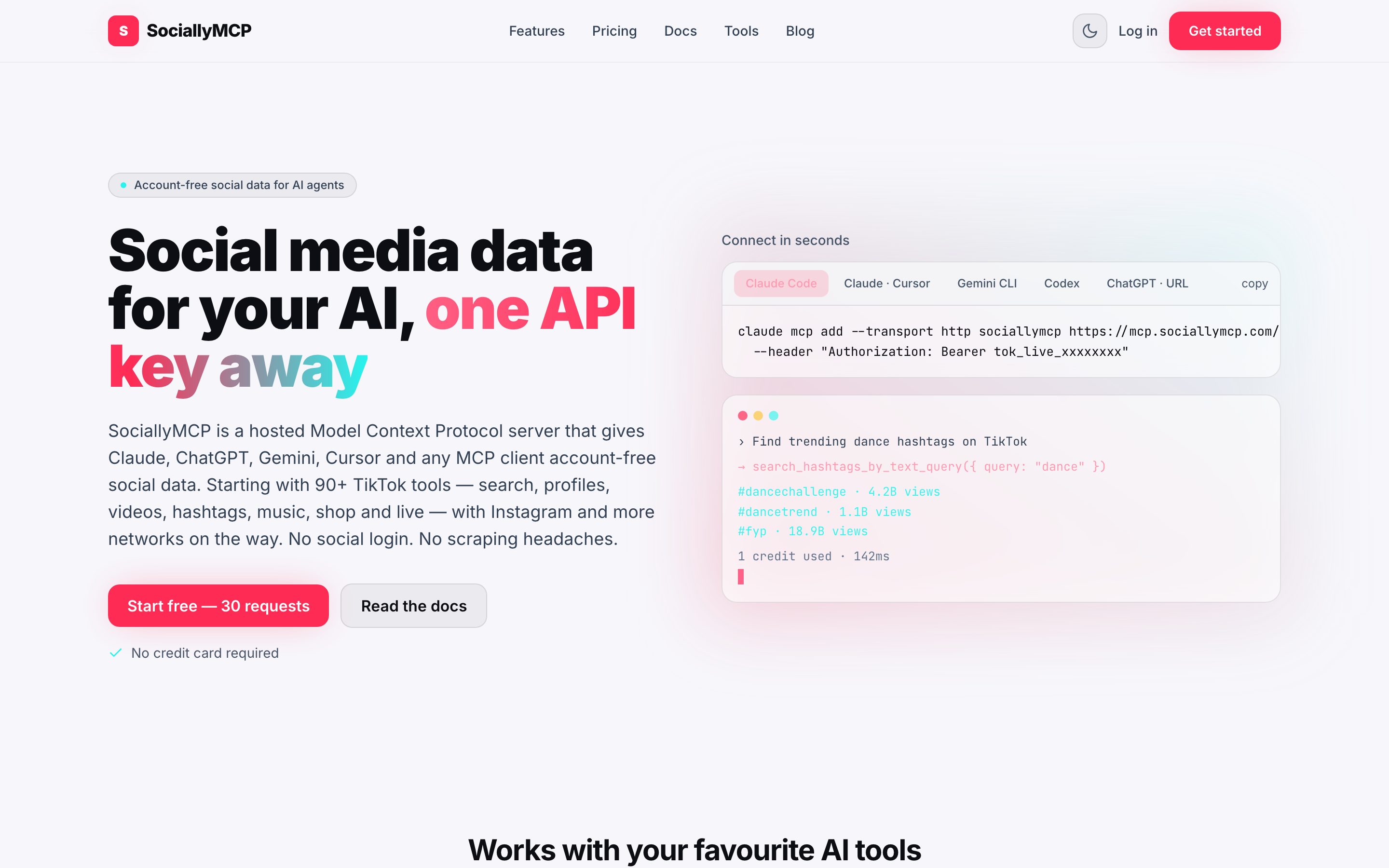
Social media data for your AI, one API key away — no login, no scraping stack.
- 90+
- typed MCP tools
- $0 → $500
- self-serve tiers
- 0 logins
- social logins needed
Context
A hosted Model Context Protocol server that gives Claude, ChatGPT, Gemini, Cursor and any MCP client account-free access to social data. 90+ TikTok tools covering search, profiles, videos, hashtags, music, shop, live, trends, locations and comments — connected with a single CLI command and a bearer token.
The product
- What it sells
- Metered API access to social data as MCP tools: 1 tool call = 1 credit, billed monthly with a hard spend cap.
- Who buys it
- Developers and teams building AI agents that need real TikTok data, who do not want to own scraping infrastructure or manage social logins.
- Pricing
- Free (30 requests) → Starter $10/1k → Growth $25/10k → Scale $130/100k → Max $500/1M requests per month, with rate limits scaling from 10/min to 100/sec.
- The wedge
- No TikTok login, session or cookie is ever required. Competing approaches need account credentials or a self-hosted scraper; this is an API key and one line of config.
The problem
AI assistants reason well about social data and cannot obtain it. Every team that wanted TikTok numbers inside an agent workflow was rebuilding the same brittle layer: infrastructure to maintain, social accounts at risk of being banned, session cookies to rotate, and response shapes that change without warning. That is weeks of undifferentiated work before the actual product starts.
Architecture
Scroll sideways to see the whole diagram
The MCP server is the contract. The client only ever sees typed tools with stable schemas; the upstream data source, its quirks, its retries and its response-shape changes all stay behind that boundary. Metering sits on the same choke point, which is why per-call billing and hard spend caps are a single implementation rather than a cross-cutting concern.
Technical specification
- Protocol
- Model Context Protocol over streamable HTTP; compatible with any MCP client, no SDK required.
- Tool surface
- 90+ TikTok tools across search, profiles, videos, hashtags, music, shop, live, trends, locations and comments.
- Authentication
- Bearer token per API key. No social platform login, session or cookie at any point.
- Onboarding
- One command: claude mcp add --transport http, plus an Authorization header carrying the API key.
- Metering
- 1 tool call = 1 credit, with monthly spend caps that hard-stop rather than overage-bill.
- Rate limiting
- Per-plan limits from 10 requests/minute on Free up to 100 requests/second on Max.
- Observability
- Customer-facing dashboard with per-request logs and usage analytics.
- Data model
- Read-only, real-time, structured JSON responses with a stable schema across platform changes.
- Roadmap
- Instagram and further networks behind the same tool interface.
How I built it
Built the integration as a Model Context Protocol server, so any MCP-capable client — Claude Desktop and Code, ChatGPT, Gemini CLI, Cursor, Windsurf, Cline, Codex — connects without a bespoke adapter.
Decomposed the surface into 90+ narrowly-scoped, well-typed tools instead of one catch-all endpoint, because an agent picks the right tool from a clear name and signature far more reliably than it constructs a correct query against a generic API.
Kept the upstream data source behind a single adapter and normalised every response into a stable JSON shape, so a change on the platform side stays contained and never reaches the customer's agent.
Made the whole thing account-free and read-only — no social login, session or cookie — which removes the ban risk and the credential-rotation burden that make the DIY route expensive.
Built metering as a first-class product feature: per-request credits, monthly spend caps with hard stops, and a dashboard with logs and analytics, so a runaway agent loop cannot produce a surprise invoice.
Reduced onboarding to a single command — `claude mcp add --transport http` with a bearer token — because setup friction is where developer-tool conversion is won or lost.
Outcome
- Shipped a self-serve developer product with a working free tier and five paid plans, from $0 to $500/month.
- Removed the entire data-infrastructure problem for the customer: no accounts, no cookies, no proxy rotation, one API key.
- Metering and spend caps made the pricing safe to adopt — an agent in a retry loop hits a hard stop, not an invoice.
- The tool-per-capability design means adding a network is additive: Instagram slots in behind the same interface without breaking existing agents.