CompraSocial.me
300,000 orders, run by two people and a lot of automation.
- 300,000+
- orders processed
- 90%
- operations automated
- 11
- social platforms
Context
A high-traffic social media marketing platform built on WordPress with custom Vue.js integrations, which has processed over 300,000 orders — with roughly 90% of daily operations handled by scripts rather than people. Eleven social platforms, four languages, and a team of two.
The product
- What it sells
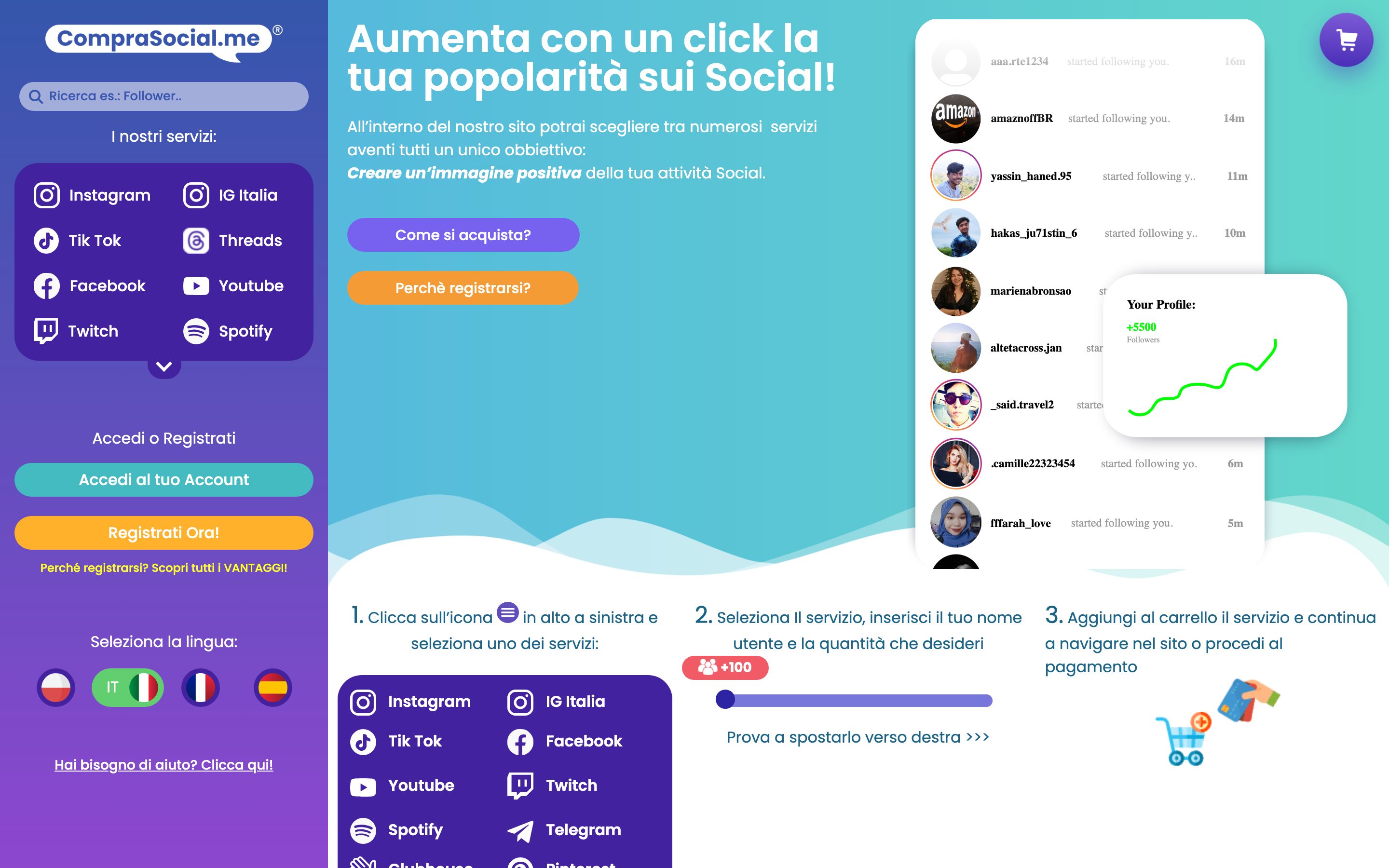
- Social media marketing and growth services — reach, engagement and audience building across Instagram, TikTok, Threads, Facebook, YouTube, Twitch, Spotify, Telegram, Clubhouse and Pinterest.
- Who buys it
- Creators and small businesses building social proof, primarily in Italy, with the storefront localised into Italian, Polish, French and Spanish.
- Retention mechanics
- A points programme ("Cristalli") for registered users plus a 10% bonus on multi-item baskets — both built to raise repeat-purchase rate rather than first-order conversion.
- Service promise
- Delivery within hours and staffed support 7 days a week — which is only affordable because the fulfilment pipeline underneath is automated.
The problem
The platform grew faster than two people could manually service. Order handling, verification, delivery tracking and customer messaging were all human tasks, and each one scaled linearly with volume — the classic point where a growing business quietly stops being profitable.
Architecture
Scroll sideways to see the whole diagram
The interesting part is not the storefront, it is the operations loop underneath it: the automation layer watches the order pipeline and only escalates the exceptions, which is what let order volume grow past 300,000 without the team growing past two.
Technical specification
- Platform
- WordPress with a bespoke theme for content and SEO, with the interactive surfaces — checkout, dashboards, order flows — replaced by custom Vue.js components against a dedicated API.
- Catalogue
- 11 social platforms, each with its own service types, quantity tiers and fulfilment routing.
- Localisation
- Four languages (Italian, Polish, French, Spanish) across storefront, checkout and transactional messaging.
- Data layer
- MySQL for the transactional store, with MongoDB behind the free-trial system — email verification and a 30-day eligibility window per address.
- Automation coverage
- ~90% of daily operations — profile checks, order validation, problem detection, dispatch, delivery and status updates — run unattended, measured by counting the recurring processes and the hours they used to take.
- Human-in-the-loop
- Refunds and disputes always escalate to a person; automation handles volume, people handle judgement.
- Acquisition
- SEO treated as an engineering concern, since organic search was the channel without a variable cost per order.
- Team
- Two people, including me — which is the whole point of the automation layer.
How I built it
Built the commercial surface on WordPress for speed and SEO, then replaced the interactive parts — checkout, dashboards, order flows — with custom Vue.js components talking to a dedicated API.
Mapped every recurring manual operation, ranked them by hours-per-week, and automated them in that order.
Wrote scripts covering the whole order lifecycle: profile checks, order validation, problem detection, dispatch, delivery tracking and status updates — with alerting on the exceptions instead of supervision of the happy path.
Ran the free-trial system on MongoDB alongside the transactional MySQL store: email-verified requests, one free service per address every 30 days, which is a write pattern that does not belong in the orders schema.
Kept a human decision point on anything involving refunds or disputes — automation handled volume, people handled judgement.
Ran SEO and content as a first-class engineering concern, since organic traffic was the acquisition channel that did not have a variable cost.
Outcome
- Over 300,000 orders processed, and still trading.
- Around 90% of daily operational work automated, counted process by process against the hours it used to take.
- The business stayed runnable by two people, because volume growth stopped translating into workload growth.