SeekUp.ai
Point it at one TikTok creator who works, get back ten who work like them.
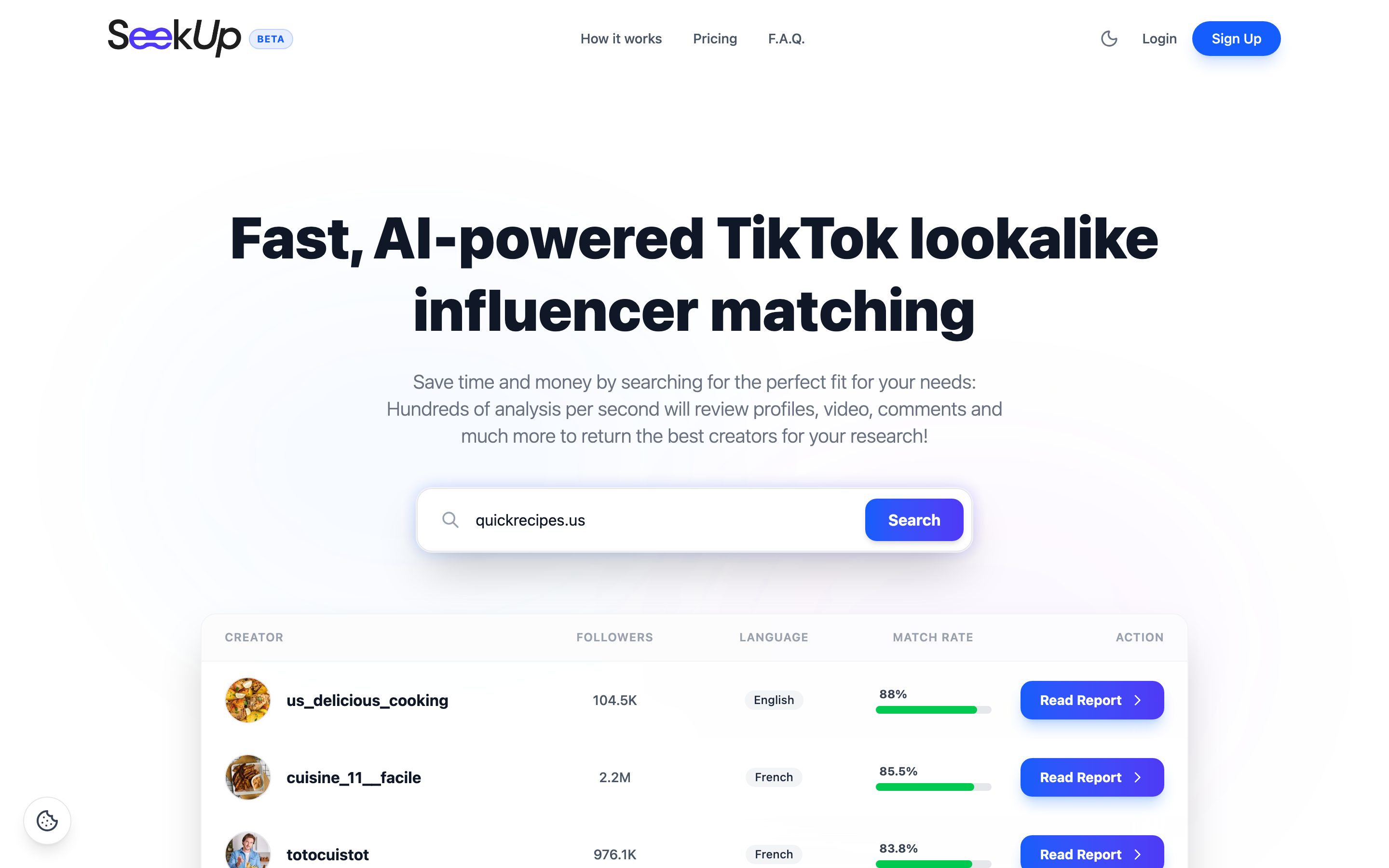
- ~5 min
- for a shortlist of ~10 creators
- up to 1,000
- profiles screened per search
- 4
- pipeline stages, ordered by cost
Context
An AI agent pipeline for influencer discovery. You give it a reference TikTok profile that already performs for your brand; a four-stage pipeline then analyses that creator, screens up to a thousand candidates, scores the survivors on four axes and returns an exportable shortlist — roughly ten matches in about five minutes. Currently in public beta.
The product
- What it sells
- Lookalike influencer discovery: campaign-ready creator shortlists with a match score and a written explanation for each candidate.
- Who buys it
- Brands and marketing teams running TikTok creator campaigns who need to scale beyond the handful of influencers they already know.
- Pricing
- Beta access at €49.99/month instead of €99.99 — a 50% launch discount, cancellable at any time.
- The wedge
- Competitors match on follower count, language and broad topic. SeekUp matches on communication style, audience type and comment sentiment — who they are versus how they actually communicate.
The problem
Finding creators who genuinely fit a brand is a manual research job: watching hundreds of videos, reading thousands of comments, judging tone. It takes days per campaign, so teams default to the few influencers they already know, and the ones they do find are picked on follower counts — a metric that says nothing about whether the audience will respond to that brand.
Architecture
Scroll sideways to see the whole diagram
The pipeline is a funnel with rising cost per candidate: cheap statistical filters run on up to a thousand profiles, expensive multimodal analysis runs only on the few that survive. That ordering is what keeps a search worth cents rather than euros, which is what makes a flat monthly price viable.
Technical specification
- Pipeline
- Four stages — reference analysis → discovery → filtering → deep comparison — each independently observable and retryable.
- Techniques
- A mix per signal: embeddings for similarity, deterministic rules for hard filters, LLM calls where judgement is required.
- Matching signals
- Topic relevance, comment analysis, content style and performance metrics, combined into a single match rate shown per candidate.
- Throughput
- Around ten compatible creators in roughly five minutes; a single search screens up to a thousand profiles on the way there.
- Data source
- Third-party social data APIs — no in-house scraping infrastructure to maintain.
- Cost control
- Cheap filters first, expensive multimodal analysis last, keeping the inference cost of a search in the cents under a flat subscription.
- Output
- CSV export plus an in-app dashboard, with a match score and written justification per creator.
- Coverage
- TikTok at launch, with Instagram and YouTube agents in development.
- Known limits
- Style matching still produces false positives, quality is uneven across languages, and a search needs a reference profile rather than adapting to a written brand brief. All three are on the roadmap.
- Status
- Public beta — fully functional, shipping frequent interface updates.
How I built it
Modelled the product as four chained stages — reference analysis, discovery, filtering, deep comparison — because each has a different cost profile and a different failure mode.
Made the first stage analyse the reference creator properly: not just statistics, but video content, style and comment threads, so the downstream search knows what it is actually looking for.
Pulled the raw social data from third-party APIs rather than building and babysitting a scraping stack — the differentiator is the analysis, not the collection.
Ordered the pipeline by cost: statistics and rule-based filters run across every candidate, and the expensive video and style analysis only runs on the ones that survive.
Mixed the techniques per signal instead of forcing everything through one — embeddings where similarity is the question, rules where the answer is deterministic, an LLM where judgement is genuinely required.
Scored every survivor on four explicit axes — topic relevance, comment analysis, content style and performance metrics — then compared each against the reference profile, so the match is inspectable rather than a single opaque number.
Made the output a CSV export and a dashboard with a written rationale per creator, because a marketing team has to justify the spend to someone else.
Outcome
- Turned a multi-day manual research task into a search that returns a scored shortlist in about five minutes.
- Made the match explainable: every candidate carries four sub-scores and a written rationale, which is what lets a marketing team act on it.
- The staged-funnel design keeps the inference cost of a search in the cents, which is what makes a flat €49.99/month price viable.
- Launched into public beta with a paid tier from day one, rather than a free pilot with no pricing signal.