CosmicUp.me
Replace seven AI subscriptions with one — 30+ models, 10,000 users, 80% off the inference bill.
- 10,000
- registered users
- 30+
- models available
- −80%
- inference cost, after context work
Context
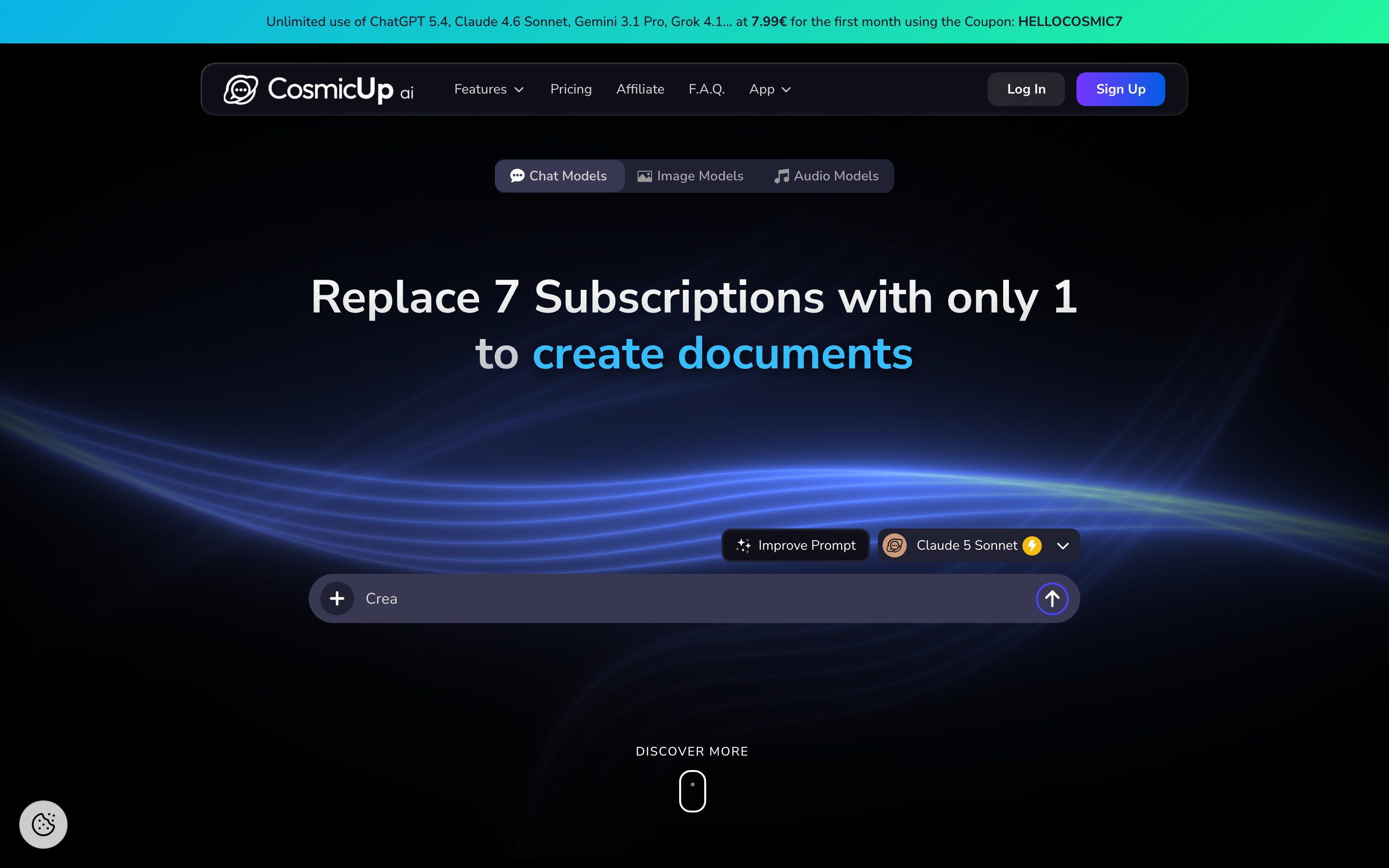
A consumer AI platform that puts 30+ chat, image and audio models behind a single €16.99/month subscription, on web, iOS and Android. It runs fully serverless, has 10,000 registered users, and stays profitable at a flat price because of what happens before each model call — retrieval, reranking and context compression, not a bigger budget.
The product
- What it sells
- One subscription replacing ChatGPT Plus, Claude, Gemini, Grok and several image and audio tools at once.
- Who buys it
- Consumers and small teams who want frontier models without paying for five separate subscriptions.
- Pricing
- Free tier, Plus at €16.99/month, or €169.90/year — positioned directly against the ~$240/year cost of ChatGPT Plus alone.
- Proof
- 10,000 registered users, 5/5 on Product Hunt, 4.1/5 on Trustpilot, plus an affiliate programme as a second acquisition channel.
The problem
People wanted to use several AI models but did not want several subscriptions, several interfaces and several billing relationships. The hard part was not the UI — it was serving unpredictable, bursty inference traffic under a flat monthly price, which means every architectural decision is also a margin decision.
Architecture
Scroll sideways to see the whole diagram
There is no single normalising gateway — every provider is integrated against its own API, because flattening them would cost exactly the capabilities people subscribe for. The leverage sits earlier: retrieval, reranking and compression decide what the model actually sees, which is where both the answer quality and the ~80% cost reduction come from.
Technical specification
- Model catalogue
- 30+ chat models, 11 image models and 2 in-house audio agents, grouped into Free, Plus and Thunder tiers.
- Providers
- Direct integrations against OpenAI, Anthropic, Google, xAI and specialised image and audio services.
- Context pipeline
- Per-request assembly: RAG with reranking, context compression and prompt caching before the model is called.
- Context windows
- Up to 1,000,000 tokens depending on the model; input accepts PDF, DOC, DOCX and 9 further formats, output writes PDF, DOC, CSV and TXT.
- Fair-use metering
- 2,000,000 input characters per month at full speed, then graceful degradation to a slower queue (2–10 min) instead of a hard cutoff — the flat price survives heavy users.
- Streaming
- Server-sent streaming end to end, so perceived latency stays low even when a slow model is doing the work.
- Code execution
- Sandboxed Python runtime (AI Code Run) invoked as a tool from the chat surface.
- Platforms
- Web, iOS and Android from a single codebase, published under CosmicUp.me on both stores.
- Payments
- Stripe on the web, native in-app purchases on iOS and Android.
- Infrastructure
- Fully serverless on Firebase and Node.js functions — no always-on servers, idle traffic costs nothing.
How I built it
Defined the product roadmap and built the whole thing on a serverless stack — Vue.js on the front, Node.js functions and Firebase behind it — so that idle traffic cost nothing.
Integrated each provider against its own API — OpenAI, Anthropic, Google, xAI and the image and audio services — rather than hiding them behind one lowest-common-denominator abstraction. The user picks the model, so the breadth of the catalogue is the product.
Put the engineering effort upstream of the model call instead: the context for each request is assembled on the fly with retrieval, reranking and context compression, so the model reads what matters and nothing else.
Added prompt caching on top of that, which together with the context work cut inference spend by around 80% — same catalogue, same answers, a fifth of the bill.
Made streaming the default so perceived latency stayed low even when a slow model was doing the work.
Designed fair-use metering that degrades instead of cutting off: past the monthly allowance a request joins a slower queue rather than failing, which keeps a flat price viable against usage that varies by orders of magnitude.
Shipped web, iOS and Android from a single codebase with a custom native wrapper, so a feature reaches every platform in one release rather than three.
Ran the growth side myself — market analysis, TikTok and Google Ads, and direct customer support — and fed the support inbox straight back into the roadmap. Interface design is my co-founder's work, not mine.
Used the logs as an abuse-control tool: unusual usage patterns get investigated, genuine abusers get banned, and when the anomaly turns out to be our own bug it gets fixed instead.
Outcome
- 10,000 registered users on infrastructure with no always-on servers and no dedicated ops team.
- Inference spend cut by around 80% through RAG, context compression and prompt caching — the single change that made a flat subscription profitable.
- The metering design kept that flat price viable against usage that varies by orders of magnitude between users.
- One codebase reaching web, iOS and Android, so the catalogue and the features stay in sync across all three.
- Support conversations turned directly into shipped features — the loop stayed short because the same person read the tickets and wrote the code.